
Human Despite Their Robes
My methodology for explaining what's going on at the Supreme Court

A big part of my day job is to explain the Supreme Court. This is my busy season. That’s not by choice. I’d much rather be out on my bicycle. But the justices save up the most significant cases from the term that starts the previous October and decide them in the last week or two of June. Then I have to read them, write columns about them, edit them down for inclusion in my casebook, and try to make sense of what it all means. As of this year, I also make videos summarizing what I’ve written. Sheesh.
People always ask me why the most important cases always get announced in a mad rush at the ed of the term. The official answer is that they’re the hardest, with the longest opinions and the most dissents that take the longest time to think through and write. That’s not the full answer, though. The truth is that the justices are drama queens. They love the buildup. They love the attention, at least when they have the opportunity to control its circumstances and timing. For a few weeks, everyone is talking about them, and that feels validating.
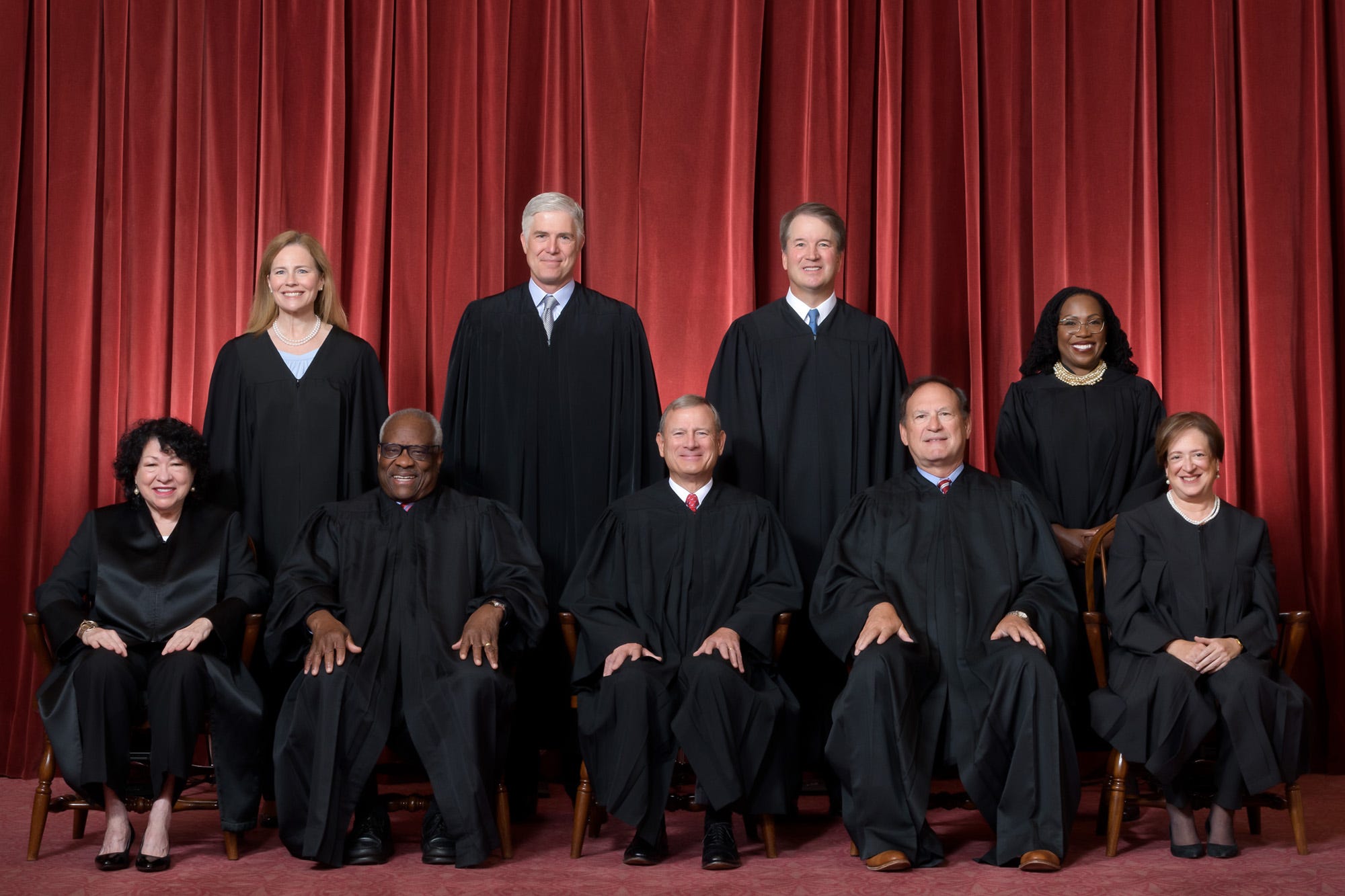
In other words, the justices are human. I discovered that as a law clerk, and it’s the touchstone to how I think about the court as an institution.
They have a very unusual job, in which the aspirational ideal is that when they put on their black robes they become embodiments of Liberty -- and correspondingly blindfolded. In theory, they should guided only by their beliefs about the meaning of the Constitution and the laws plus the right methodology for interpreting them.
But because they are human, their characters and personalities and intelligence and temperament and ambition and irritations matter. They matter a lot. The justices form alliances and friendships, and they also trigger and alienate each other in highly specific ways. Meanwhile, everything they do is in some way related to the reality of politics, no matter what they’re individual attitudes to that unavoidable fact may be.
The truth is that the justices are drama queens.
Also, because the justices serve until they die or choose to retire, their beliefs evolve and change. That dynamic evolution doesn’t follow some preset pattern, but exists in constant interaction with their personalities and their relationships. They spend a long time on the court, which means they get older, which has been known to affect people’s beliefs and personalities.
So when I explain the Court, I spend a lot of time on the personalities of the individual justices, their jurisprudential commitments, their judicial instincts, their, and how those are going to intersect in any given case.
For example, why did Justice Brett Kavanaugh, who almost always votes with the conservative wing of the Court, defected and join Chief Justice John Roberts and the Court’s three liberals to preserve the independence of the Federal Reserve Bank by a single vote?
To answer that adequately, you have to know that Kavanaugh has a little more room for pragmatic, real-world consequences in his jurisprudence than do the other conservatives. Contrast that with Justice Amy Coney Barrett, a direct disciple of the late Justice Antonin Scalia, believes it isn’t the justices’ job to try and guess what will happen in the real world depending on what they decide. Kavanaugh, who clerked for Justice Antony Kennedy, was therefore willing to say in his solo concurrence in Trump v. Cook that “even temporary uncertainty about the status of the Federal Reserve could spark political upheaval … as well as turmoil in the U.S. and world economies.”
But that’s not all you need to know. It’s also relevant that Kavanaugh, born and raised in Washington, DC, justly prides himself on his insider’s understanding how the government works. Several other justices worked as lawyers in the executive branch, but Kavanaugh’s experience extends beyond just being a White House lawyer. He was staff secretary to George W. Bush, a job that puts you at the heart of White House policymaking. Kavanaugh therefore has more first-hand political experience than any other justice. The confidence with which he writes about policy consequences for breaking fed independence shows you just how much he cares about making things work -- and how comfortable he is telling you that he does.
I could say a lot more about the interplay of forces that affect Kavanaugh. I could offer you similar theories about the other eight, combining their jurisprudence with their background, experiences, beliefs, and commitment.
I wrote an entire book, Scorpions, about FDR’s great Supreme Court justices, in which I first used this method. And yes, if anyone cared, I could account for my own methodology the way I can account for the justices’.
And let me be clear, not everyone likes my approach. Many people think the only thing that matters in understanding the Supreme Court is the justices’ politics.
It’s absolutely true that, in their jurisprudential views and their political ideologies, the justices are affected by major political trends. And of course they have to be nominated by the president and confirmed by a majority of the Senate, which makes the political process highly relevant to their selection.
People think the only thing that matters in understanding the Supreme Court is the justices’ politics. There’s a lot more to it than that.
But once they’re on the court, the justices are extraordinarily insulated from political pressures, except the ones they want to take on board. They can’t be fired. Since the 1960s, they have all spent the rest of their careers on the bench rather than taking up other jobs after a resignation. The only promotion available is to Chief Justice of the United States, and it’s extremely unusual for a sitting justice to get that job, because it would require a fresh confirmation hearing for the promotion. (The last time a sitting justice was promoted to chief justice was in 1986 when William H. Rehnquist was made chief by Ronald Reagan. Before that, you have to go back to 1945 when FDR promoted Harlan Fiske Stone.)
The institution is also very small, which ensures lots of interaction, at least on professional terms, during the long term that the justices typically serve (nearly 30 years, on average). The Justices are always responding to one another, whether in opinions or in internal discussions. The politics of small groups are distinctive and fascinating. The inner politics of the Supreme Court are a topic of extraordinary complexity that is surprisingly difficult to model from the outside.
The upshot is that there’s a lot going on beyond politics, which itself is a dynamic and ever-changing category. The justices care a lot about their reputations, which are made in part by the press but, to a greater degree over the long term, by constitutional law professors who determine the lists of great justices. In that way, my little guild resembles that of the sports writers who have a vote on who gets into the Baseball Hall of Fame. The justices want to stand for certain constitutional values and ideas. They mostly want to be seen as consistent. All this matters, and all this goes way beyond the ordinary meaning of political ideology.
The justices care a lot about their reputations. They can’t get promoted, they can’t earn more. It’s all about going down in history.
For many academics, focusing too much on the individual characteristics of the justices feels almost like an insult to their work. Those scholars prefer to focus on bigger trends, whether in the law itself or in political and social movements. They tend to think that explaining the outcomes of cases in terms of individual jurisprudence, ideology, and character is small-minded because it doesn’t pay enough attention to those grand forces.
I vividly recall when I presented the basic ideas of Scorpions to the Legal Theory workshop at the Yale Law School. Quite a few of my law school teachers were participants. One in particular, the wildly creative scholar Bruce Ackerman, who influenced my whole generation of constitutional law professors by bringing us back to constitutional history, expressed what seemed like genuine frustration with what I was doing. For him, Supreme Court opinions were best understood as products of the big sweep of constitutional movements. The fact that the justices were humans was an extremely embarrassing fact, one it seemed to me he would prefer that I ignore.
All this is not to say that a smart political scientist or an AI can’t predict how the justices will come out on many cases. They can. Prediction of outcomes, however, isn’t by any means the whole story. How the justices write their opinions, what they write, and how they build the edifice of law is where much of the action is. It’s where all of the action is that seems most interesting to me.
That’s why, when you read my columns or books or watch my videos or sit in my classroom, you’ll hear about where the justices come from and what they’re like in person and what I think are their aspirations and ambitions. I will try to locate them in their ideas in the long stream of constitutional thought in America. I will try to connect what they’ve written to history and philosophy and anthropology and social theory and class consciousness and individual psychology and regional identity and gender and race.
Ultimately, I judge the justices against the criterion of their own stated jurisprudential commitments. That’s what the job is supposed to be, even if no human being could ever fully accomplish it. Putting on a robe means you’re supposed to try and be consistent and explain why you’re doing what you’re doing with clarity and a degree of transparency. But it’s no sin not to succeed. None of the greatest justices ever has.
Professor I enjoyed reading this piece. Your past experience as a law clerk to Supreme Court Justices must have given you opportunity to observe them from a closer distance! Your attempt to observe a more humane side of Supreme Court justices was very refreshing. The quote on Justice Kavanaugh's emphasis on maintaining central bank independence was also interesting.
Another brilliant and incisive analysis from a scholar at the top of his game. I see now why the muses blessed (cursed?) you with the gift and compulsion (if that is the right word) to put thoughts to prose and enlighten us all. Keep it up. You are a beacon of clarity in this period of seemingly unending strife, acrimony and political polarization.