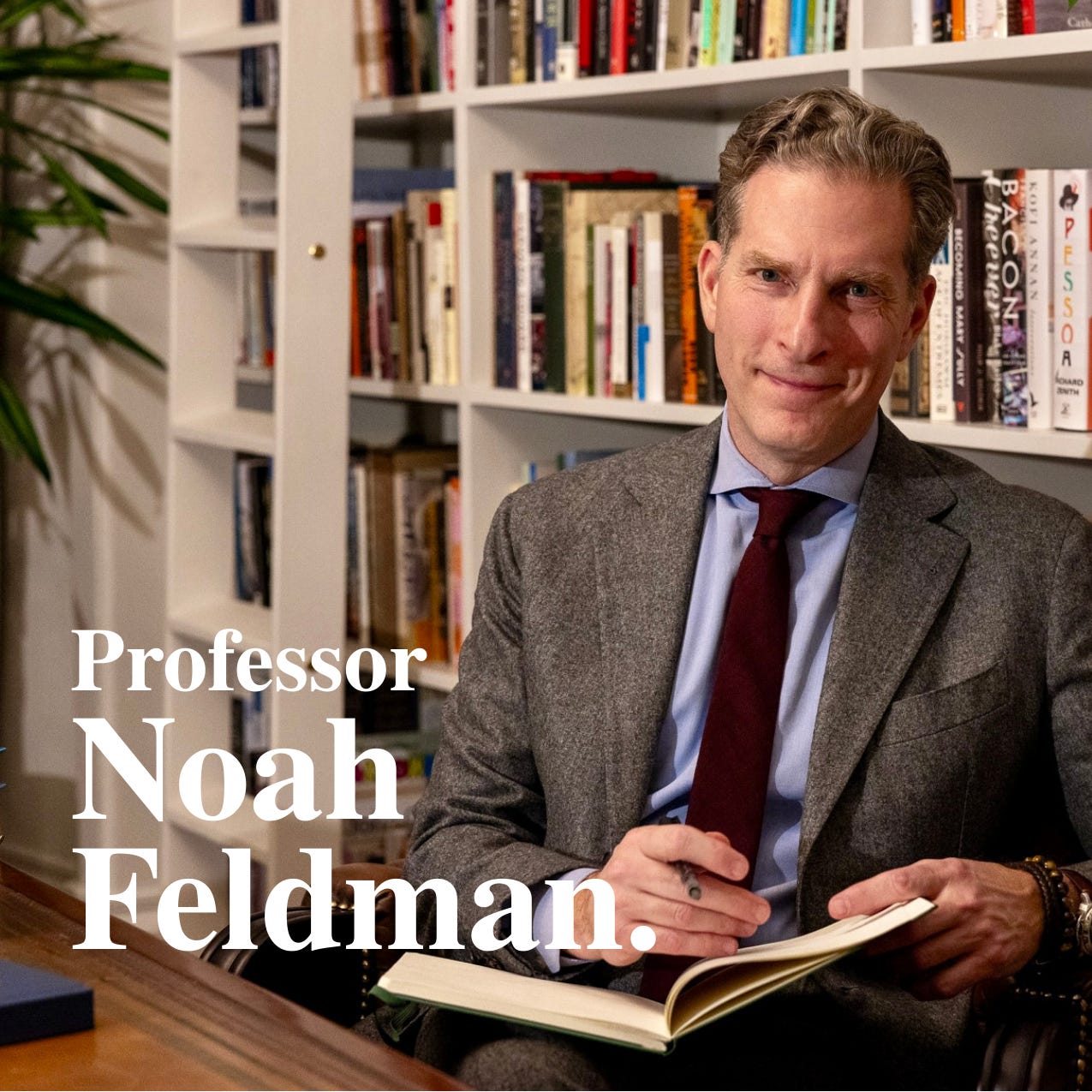
This was my first-ever Ask a Professor live, which means it was an experiment: me reading questions off a screen, trying to answer them with some clarity, and discovering in real time what kinds of things people actually want to ask when the format is open and the stakes are, in a way, personal.
Here’s a brief recap of the questions we explored together:
When constitutional values collide
Professor Feyzan Olgunsoy, a constitutional law professor in Turkey, asked one of the most fundamental questions in constitutional theory: what happens when the core principles written into a constitution—liberty, equality, democracy, secularism—come into tension with each other?
I discussed how this problem shows up in the United States as a conflict between liberty and equality, and why former Supreme Court Justice David Souter’s approach—drawing on history, tradition, and humility—offers one way of navigating conflicts that cannot be perfectly resolved.
Can a president go to war without Congress?
A live question from Oliver asked for the strongest version of the argument that a president can initiate military action—specifically bombing—from the air without congressional authorization.
We walked through the legal argument used by lawyers during the Obama administration and likely to be invoked by others as well, and why I believe it misunderstands both the Constitution and the War Powers Resolution. When a president can unilaterally initiate war, the danger is not merely legal—it risks creating what historians have long called the imperial presidency.
How do you pursue deep knowledge without losing your life in the process?
Xiu Lim, a student at Columbia University, asked a question I hear constantly from ambitious students: how can you pursue deep learning while still savoring life in the present?
My answer was partly practical and partly philosophical. Deep knowledge takes time and effort. But we can make the process meaningful by pausing—even briefly—to recognize how lucky we are to be learning at all. And just as importantly, every culture has understood the need for structured rest—whether the Sabbath, prayer, or meditation. Without intentional breaks, work eventually drains meaning rather than creating it.
Preparing for a Supreme Court clerkship
Christopher Gonzales, an undergraduate aiming for a Supreme Court clerkship, asked what mistakes I made on that path and what investments mattered most.
The key insight was that success often depends on understanding the needs of the person you will work for. Professors reward creativity; judges often prioritize precision, reliability, and careful research. Mentorship, in turn, grows from attention to detail and relationships built over time.
How to actually find a mentor
Relatedly, we talked about how mentorship works. Students often ask directly to be mentored, but mentorship usually develops organically. The simplest starting point is to engage seriously with a professor’s work—read something they’ve written, ask a thoughtful question, and begin a conversation. Mentorship grows from mutual intellectual engagement, not a single request.
How do we live with people we think are wrong—or even immoral?
One of the most difficult questions came from a student describing the intensity of political conflict on campus today, particularly around Israel and Zionism.
The deeper issue, though, is broader: how do we form relationships with people whose views we believe are profoundly mistaken?
My answer began with a distinction. People may be wrong because they are reasoning in bad faith—or because they are reasoning in good faith but have reached the wrong conclusion. If we assume the latter more often than we do today, we create the possibility of conversation and shared citizenship even in a deeply polarized society.
Can the two-party system be challenged legally?
Matt Blumberg asked whether the two-party duopoly in American elections could be challenged in court, especially given the growing number of voters who identify as independent.
We explored the legal complexities: political parties are private organizations, yet states administer the primaries that determine nominees. That overlap between private association and state action raises interesting constitutional questions—but also explains why breaking the two-party structure is harder than it might initially seem.
Charity, values, and effectiveness
An anonymous reader described a dilemma about charitable giving. Their company foundation matches donations—but only to certain charities that may not reflect their personal values.
This raised a classic philosophical question. Should charitable giving maximize measurable impact, as the effective altruism movement suggests? Or is giving also a way to express personal moral commitments? In many cases, both considerations matter—and sometimes the right answer is to follow your values even when the financial impact is smaller.
Why do political parties exist at all?
Michelle, an independent voter, asked why political parties exist if many voters prefer to evaluate candidates individually.
The short answer is that parties solve a coordination problem in large democracies. Even James Madison, who originally hoped the Constitution would prevent parties from forming, ultimately helped found one himself after realizing that coalitions were necessary to influence government.
What do freshmen misunderstand about careers?
Sue asked what I misunderstood about careers when I was a freshman in college.
My answer was simple: careers are built as much through relationships as through achievement. When I was younger, I believed success depended almost entirely on doing the assigned work well. In reality, friendships, mentorship, and professional relationships often shape opportunities just as much.
Conscience vs. responsibility
Another question raised the tension between following one’s independent conscience and accepting practical advice.
To think about this, I drew on the sociologist Max Weber, who distinguished between an ethic of conscience—acting according to moral conviction—and an ethic of responsibility—acting based on the consequences your actions will produce. Both have their place, and wisdom often lies in recognizing which framework fits the situation.
AI (more to come)
MS asked what I had learned during several weeks studying artificial intelligence. I promised to return to this topic soon—because the subject is too important to answer quickly.
And finally: clothes
Finally, Eric Krebs, a law student, asked why people used to dress more formally at universities and whether there is a happy medium between suits and pajamas.
Clothing, I suggested, is a form of expression. Dressing thoughtfully—whatever that means for you—is a way of signaling that what you’re doing that day matters. Every culture has used clothing to express meaning. Universities shouldn’t be the first place where that stops.
Thanks for joining
And please keep the questions coming. You can email them anytime at ask@professornoahfeldman.com, or simply leave a comment on this post. One of the pleasures of this format is that it turns writing into a conversation … and the best conversations start with good questions.